Functions
The functions provides may be divided into several groups:
- built-in functions - without prefix - various basic constructions e.g. used for operations on captions, dates,
- built-in functions - dictionaries.
Available after the prefix dic. The key value should always be given as an argument. The name of the column-key is included in the function name.
Two groups of the function variants are available for each dictionary:
- a group which returns the entire dictionary row,
- a group which returns the selected column only (given as the function argument).
- built-in functions - parsers,
- external functions - available by prefixes registered with the use of the option of attaching the external
.NETcode (menu Package).
Example: If the "plug in" code named WorkflowController is registered as the prefix "workflow", the functions WorkflowStart() and WorkflowPing used for launching processes and waking them up from the 'sleeping' activities (Timeout/Form) will additionally appear among the available functions.
5. CLR static functions - all static methods of .NET libraries loaded into the application domain. Available by the full name of the type declaring that method, e.g.:
System.String.Concat(Clients\Name, " ", Clients\Surname)
Construction of functions
The list of available functions is divided into sections and can be accessed in the expression editor window or by pressing Ctrl+Space in the Details panel.
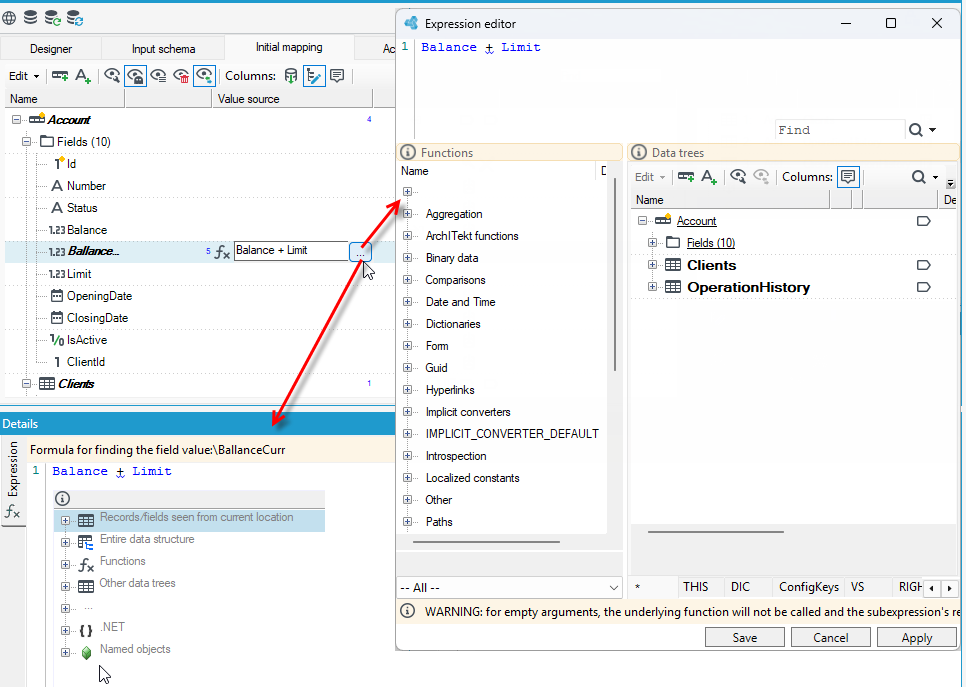
The functions you can use in the platform are listed below. Each function is supported by a description of how the function should be built. Function syntax hints are also available in the expression editor.
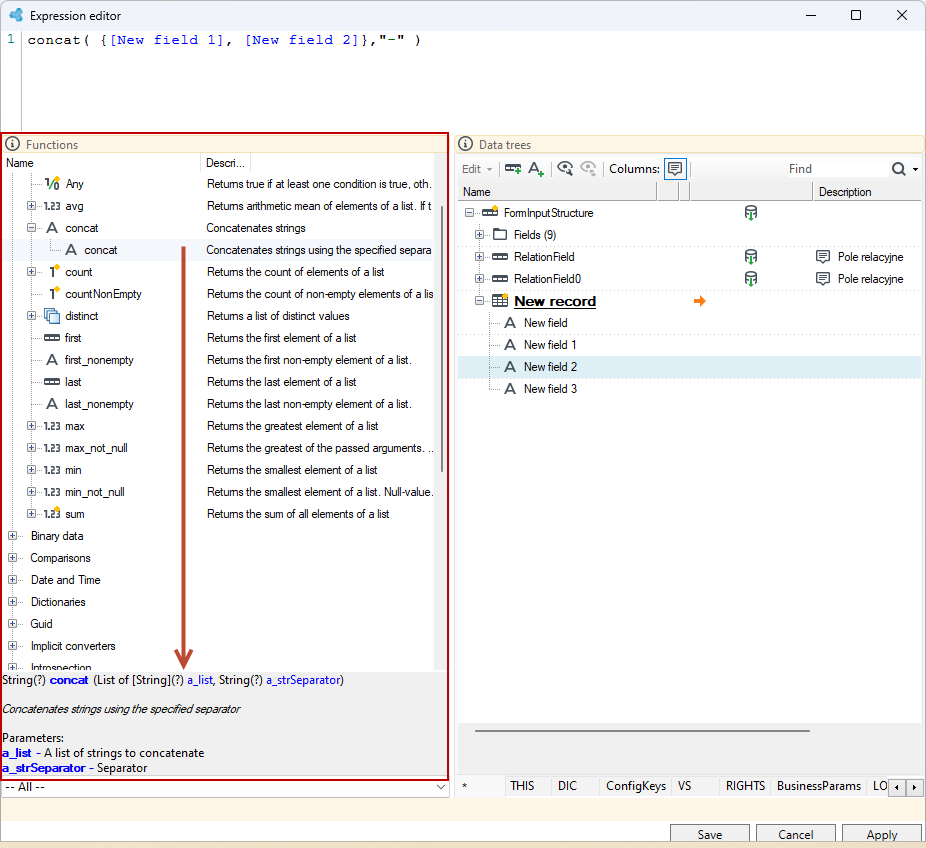
- Go to the advanced expression editor. On the left side of the window, all the functions you can use are collected. Select a function, and the syntax of the function to be used and the parameters that the function takes will be displayed below.
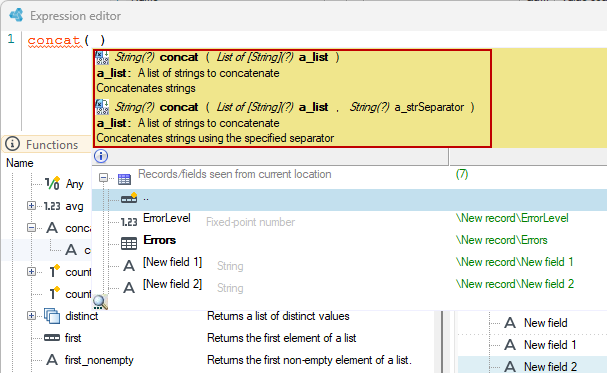
- Enter the function in the expression editor and position the cursor in the middle of the parentheses, where the components of the function should be.
- Click CTRL+Space.
- The syntax prompt window that appears will also tell you how to build the function.
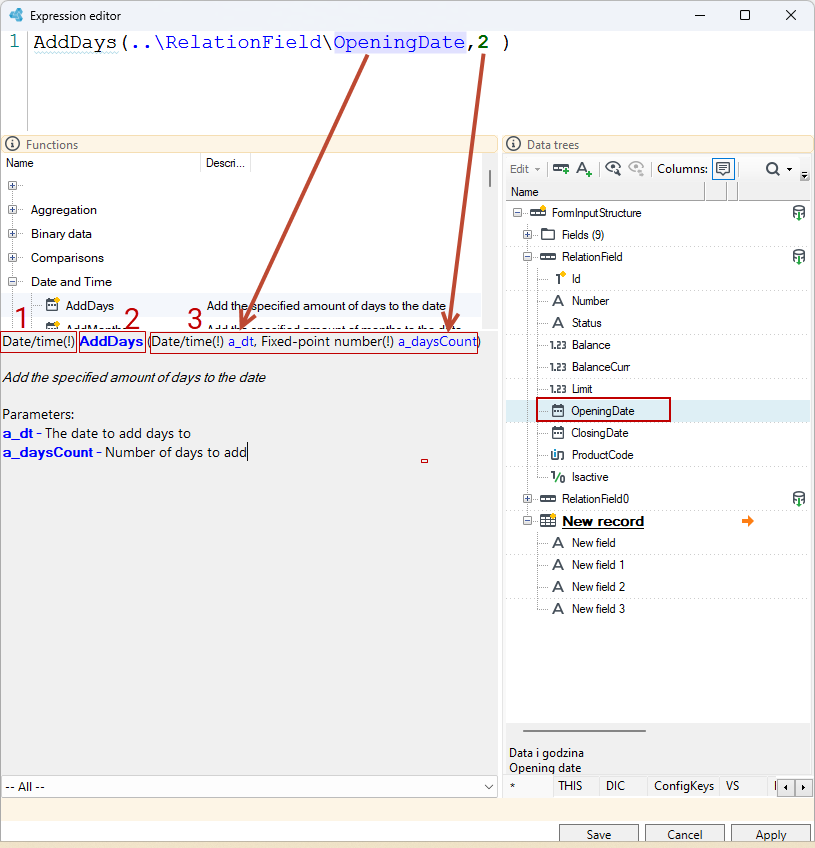
In the function description you will find:
- The value that the function returns
- The function used
- The parameters of the function to be specified
For example:
The following example uses the function AddDays (2), which will return the data type as Date/Time (1) . For the function, you need to specify the parameters (3) a_dt, which is the date to which days will be added, in this case it is OpeningDate field, and the parameter a_daysCount, which is the number of days to be added: 2.
Below is the use of the function with a view on the form:
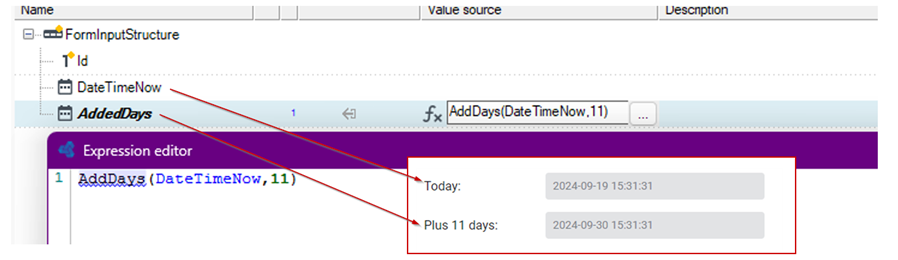
You can use several functions in an expression as in the example below:
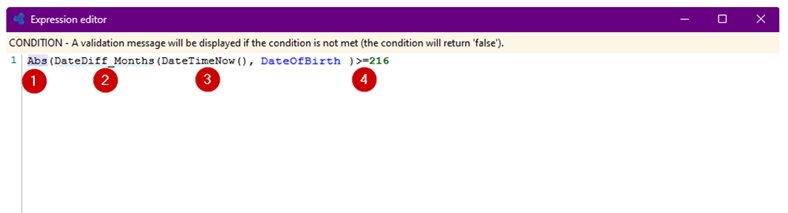
-
Absolute value function
-
Function of the difference of the number of months between dates
-
Function that returns the current date and time
-
Mathematical operator: greater than or equal to
Tips
- If the function takes a list of elements as parameters, remember to use the braces parenthneses
{ }
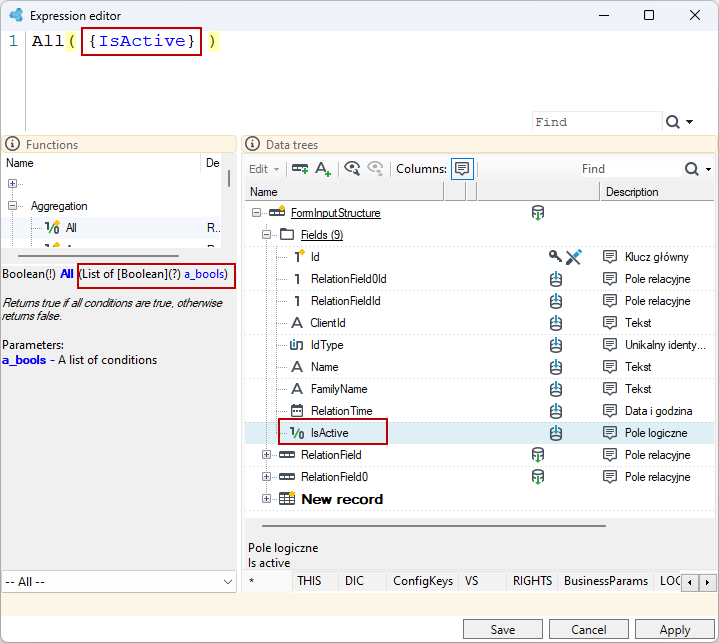
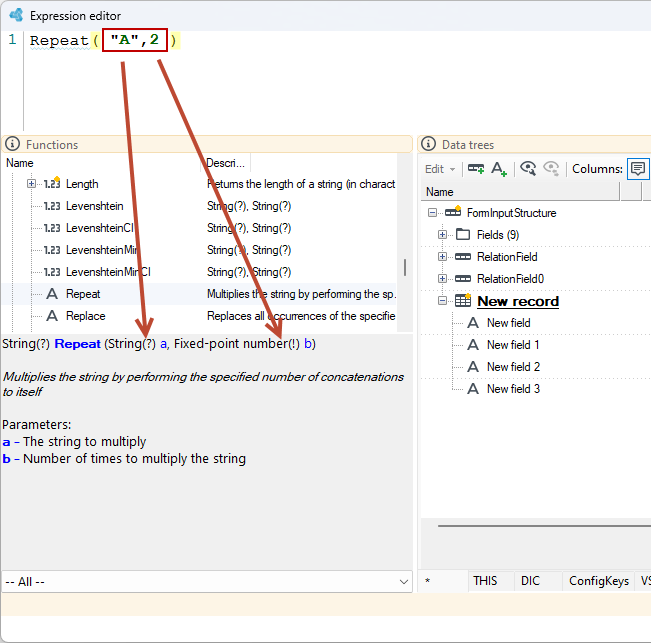
- If the function accepts text and you want to use constant text without referring to a field from the data schema, enter the text in quotation marks.
- In this case, in the
Repeatfunction, the string A will be duplicated 2 times.
Scalar functions in the context of a list
The Mappings language has an interesting property which simplifies writing of scalar operations on lists which usually allow for aggregations. In order to know the maximum length of the client's surname you should write:
max(Length(Clients\Surname))
Although the function Length() takes a single string (not a list of strings) as an argument, such notation will be correct. The list of the component strings length will be provided to the function max and the maximum value will be taken of it.
The rule that has been described works for all functions having scalar arguments in which there are attempts to provide the list. The result will also be a list. If there is a greater number of arguments of the list type, the result will include the values of the function calculated on the Cartesian product of the arguments. Therefore, the result of the following expression may be surprising:
max( Length(Clients\Surname+ Clients\Name) )
In such case, the length of the longest possible concatenation of name and surname from among multiple records Clients will be obtained.
Using regular expressions
Regular expressions in expressions
Expressions often make use of regular expression eg. to:
- check whether a string matches the pattern (the
LikeRgx,LikeRgx_CIoperators), - divide a string with a pattern,
- select pattern named groups from a string,
- replace a pattern matching with another indicated pattern.
Regular expressions always occur as string constants and they have not been built-in as e.g. in the Perl language yet.
Paths to fields and records, generic value types
Some specific functions which operate on records (e.g. Get the specific field value, Find records in which specific field equals specific value, general functions from the ‘records’ category) get a relative path to a field/record as an argument. In this argument’s place, a string constant with a path or a field/record reference which will be changed into and suggested as a path - depending on the particular function’s semantics - may occur. It means that even in this place schema element names do not have to be written manually.
Returned values types will often depend e.g. on the type of the indicated field which is also taken into consideration at the stage of writing an expression – type conversion or casting are not necessary.
Moreover, functions which return records at the design stage have an output schema which is used in path suggestion
An example of an aggregate:
GetFieldValue(
last( GetRecordSet(\[al.TRANS\_OKRESOWE], ALN\_OPER\_KLI, true )),
ALTTR\_DATAKS
)
..that is: take the DATAKS field from the last of TRANS OKRESOWE records where OPER KLI=true`
Note that:
GetRecordSet– the second argument looks like a common data reference in the current context. However, it is a a value of the new “path” type, calculated from the start point indicated by the first argument. An invoked function has complete knowledge of paths, types, multiplicities, etc. at the moment of compilation and may use it while matching (a starting point shift) and validating (returning errors and warnings).GetFieldValue– a CC function dynamic dispatch is used for verifying whether the second argument is a path leading to a “single” context and to returning to expressions the target method which returns the value of the type the same as the path’s target.
To get logical predicates, they should be added to multiple records e.g. as technical fields.
Aggregation
All
Boolean
All (Collection[Boolean] a_bools)
Returns true if all conditions are true, otherwise returns false.
Parameters:
a_bools - A list of conditions
Any
Boolean
Any (Collection[Boolean] a_bools)
Returns true if at least one condition is true, otherwise returns false.
Parameters:
a_bools - A list of conditions
avg
Fixed -point number
avg (Collection[Fixed-point number] a_list)
Arithmetic mean of numbers
Parameters:
a_list - A list of elements which mean will be returned.
Fixed-point number
avg (Collection[Floating-point number] a_list)
Arithmetic mean of numbers
Parameters:
a_list - A list of elements which mean will be returned.
Fixed-point number
avg (Fixed-point number a_scalar)
Arithmetic mean of numbers. A function interprets a given argument as a one-element list.
Parameters:
a_scalar - An element which will be returned
Floating-point number
avg (Floating-point number a_scalar)
Arithmetic mean of numbers. A function interprets a given argument as a one-element list.
Parameters:
a_scalar - An element which will be returned
Date/time
avg (Date/time a_scalar)
Arithmetic mean of numbers. A function interprets a given argument as a one-element list.
Parameters:
a_scalar - An element which will be returned
concat
String
concat (Collection[String] a_list)
Concatenates strings
Parameters:
a_list - A list of strings to be concatenated
String
concat (Collection[String] a_list, String a_strSeparator)
Concatenates strings with the use of a given separator.
Parameters:
a_list - A list of strings to be concatenated
a_strSeparator - Separator
count
Fixed-point number
count (Fixed-point number a_scalar)
Amount of elements. A function interprets a given argument as a one-element list. It always returns 1.
Parameters:
a_scalar - An element which will be counted
Fixed-point number
count (Floating-point number a_scalar)
Amount of elements. A function interprets a given argument as a one-element list. It always returns 1.
Parameters:
a_scalar - An element which will be counted
Fixed-point number
count (Identifier (GUID) a_scalar)
Amount of elements. A function interprets a given argument as a one-element list. It always returns 1.
Parameters:
a_scalar - An element which will be counted
Fixed-point number
count (Date/time a_scalar)
Amount of elements. A function interprets a given argument as a one-element list. It always returns 1.
Parameters:
a_scalar - An element which will be counted
Fixed-point number
count (String a_scalar)
Amount of elements. A function interprets a given argument as a one-element list. It always returns 1.
Parameters:
a_scalar - An element which will be counted.
Fixed-point number
count (Any a_list)
Returns the amount of elements in a list.
Parameters:
a_list - A list of elements amount of which will be returned
Fixed-point number
count (DataRecord a_dataRecord)
Returns the amount of elements in a list
Parameters:
a_dataRecord - A list of elements amount of which will be returned
countNonEmpty
Fixed-point number
countNonEmpty (Any a_list)
Returns the amount of elements in a list which are not empty values
Parameters:
a_list - A list of elements amount of which will be returned
first
Fixed-point number
first (Fixed-point number a_scalar)
Returns the first element of a list. A function interprets a given argument as a one-element list.
Parameters:
a_scalar - An element which will be returned
Floating-point number
first (Floating-point number a_scalar)
Returns the first element of a list. A function interprets a given argument as a one-element list.
Parameters:
a_scalar - An element which will be returned
Identifier (GUID)
first (Identifier (GUID) a_scalar)
Returns the first element of a list. A function interprets a given argument as a one-element list.
Parameters:
a_scalar - An element which will be returned
Date/time
first (Date/time a_scalar)
Returns the first element of a list. A function interprets a given argument as a one-element list.
Parameters:
a_scalar - An element which will be returned.
String
first (String a_scalar)
Returns the first element of a list. A function interprets a given argument as a one-element list.
Parameters:
a_scalar - An element which will be returned
Fixed-point number
first (Collection[Fixed-point number] a_list)
Returns the first element of a list
Parameters:
a_list - A list which first element will be returned
Floating-point number
first (Collection[Floating-point number] a_list)
Returns the first element of a list
Parameters:
a_list - A list which first element will be returned
String
first (Collection[String] a_list)
Returns the first element of a list
Parameters:
a_list - A list which first element will be returned
Identifier (GUID)
first (Collection[Identifier (GUID)] a_list)
Returns the first element of a list
Parameters:
a_list - A list which first element will be returned
Date/time
first (Collection[Date/time] a_list)
Returns the first element of a list
Parameters:
a_list - A list which first element will be returned
first_nonempty
String
first_nonempty (Collection[String] a_list)
Returns the first element of a list, which is not an empty value
Parameters:
a_list - A list which first non-empty element will be returned
last
Fixed-point number
last (Fixed-point number a_scalar)
Returns the last element of a list. A function interprets a given argument as a one-element list.
Parameters:
a_scalar - An element which will be returned
Floating-point number
last (Floating-point number a_scalar)
Returns the last element of a list. A function interprets a given argument as a one-element list.
Parameters:
a_scalar - An element which will be returned
Identifier (GUID)
last (Identifier (GUID) a_scalar)
Returns the last element of a list. A function interprets a given argument as a one-element list.
Parameters:
a_scalar - An element which will be returned
Date/time
last (Date/time a_scalar)
Returns the last element of a list. A function interprets a given argument as a one-element list.
Parameters:
a_scalar - An element which will be returned
String
last (String a_scalar)
Returns the last element of a list. A function interprets a given argument as a one-element list.
Parameters:
a_scalar - An element which will be returned
Fixed-point number
last (Collection[Fixed-point number] a_lis t)
Returns the last element of a list
Parameters:
a_list - A list which last element will be returned
Floating-point number
last (Collection[Floating-point number] a_list)
Returns the last element of a list
Parameters:
a_list - A list which last element will be returned
String
last (Collection[String] a_list)
Returns the last element of a list
Parameters:
a_list - A list which last element will be returned
Identifier (GUID)
last (Collection[Identifier (GUID)] a_list)
Returns the last element of a list
Parameters:
a_list - A list which last element will be returned
Date/time
last (Collection[Date/time] a_list)
Returns the last element of a list
Parameters:
a_list - A list which last element will be returned
last_nonempty
String
last_nonempty (Collection[String] a_list)
Returns the last element of a list, which is a non-empty value
Parameters:
a_list - A list which last non-empty element will be returned
max
Fixed-point number
max (Collection[Fixed-point number] a_list)
Returns the largest element of a list
Parameters:
a_list - A list which largest element will be returned
Fixed-point number
max (Fixed-point number a0, Fixed-point number a1)
Returns the largest element of the ones given in arguments
Parameters:
a0 - First argument used in a comparison
a1 - Second argument used in a comparison
Fixed-point number
max (Fixed-point number a0, Fixed-point number a1, Fixed-point number a2)
Returns the largest element of the ones given in arguments
Parameters:
a0 - First argument used in a comparison
a1 - Second argument used in a comparison
a2 - Third argument used in a comparison
Fixed-point number
max (Fixed-point number a0, Fixed-point number a1, Fixed-point number a2, Fixed-point number a3)
Returns the largest element of the ones given in arguments
Parameters:
a0 - First argument used in a comparison
a1 - Second argument used in a comparison
a2 - Third argument used in a comparison
a3 - Fourth argument used in a comparison
Floating-point number
max (Collection[Floating-point number] a_list)
Returns the largest element of a list
Parameters:
a_list - A list which largest element will be returned
Floating-point number
max (Floating-point number a0, Floating-point number a1)
Returns the largest element of the ones given in arguments
Parameters:
a0 - First argument used in a comparison
a1 - Second argument used in a comparison
Floating-point number
max (Floating-point number a0, Floating-point number a1, Floating-point number a2)
Returns the largest element of the ones given in arguments
Parameters:
a0 - First argument used in a comparison
a1 - Second argument used in a comparison
a2 - Third argument used in a comparison
Floating-point number
max (Floating-point number a0, Floating-point number a1, Floating-point number a2, Floating-point number a3)
Returns the largest element of the ones given in arguments
Parameters:
a0 - First argument used in a comparison
a1 - Second argument used in a comparison
a2 - Third argument used in a comparison
a3 - Fourth argument used in a comparison
String
max (Collection[String] a_list)
Returns the largest element of a list
Parameters:
a_list - A list which largest element will be returned
String
max (String a0, String a1)
Returns the largest element of the ones given in arguments
Parameters:
a0 - First argument used in a comparison
a1 - Second argument used in a comparison
String
max (String a0, String a1, String a2)
Returns the largest element of the ones given in arguments
Parameters:
a0 - First argument used in a comparison
a1 - Second argument used in a comparison
a2 - Third argument used in a comparison
String
max (String a0, String a1, String a2, String a3)
Returns the largest element of the ones given in arguments
Parameters:
a0 - First argument used in a comparison
a1 - Second argument used in a comparison
a2 - Third argument used in a comparison
a3 - Fourth argument used in a comparison
Date/time
max (Collection[Date/time] a_list)
Returns the largest element of a list
Parameters:
a_list - A list which largest element will be returned
Date/time
max (Date/time a0, Date/time a1)
Returns the largest element of the ones given in arguments
Parameters:
a0 - First argument used in a comparison
a1 - Second argument used in a comparison
Date/time
max (Date/time a0, Date/time a1, Date/time a2)
Returns the largest element of the ones given in arguments
Parameters:
a0 - First argument used in a comparison
a1 - Second argument used in a comparison
a2 - Third argument used in a comparison
Date/time
max (Date/time a0, Date/time a1, Date/time a2, Date/time a3)
Returns the largest element of the ones given in arguments
Parameters:
a0 - First argument used in a comparison
a1 - Second argument used in a comparison
a2 - Third argument used in a comparison
a3 - Fourth argument used in a comparison
Fixed-point number
max (Fixed-point number a_scalar)
Returns the largest element of a list. A function interprets a given argument as a one-element list.
Parameters:
a_scalar - An element which will be returned
Floating-point number
max (Floating-point number a_scalar)
Returns the largest element of a list. A function interprets a given argument as a one-element list.
Parameters:
a_scalar - An element which will be returned
Identifier (GUID)
max (Identifier (GUID) a_scalar)
Returns the largest element of a list. A function interprets a given argument as a one-element list.
Parameters:
a_scalar - An element which will be returned
Date/time
max (Date/time a_scalar)
Returns the largest element of a list. A function interprets a given argument as a one-element list.
Parameters:
a_scalar - An element which will be returned
String
max (String a_scalar)
Returns the largest element of a list. A function interprets a given argument as a one-element list.
Parameters:
a_scalar - An element which will be returned
max_not_null
Fixed-point number(?)
max_not_null (List of [Fixed-point number](?) a_list)
Returns the greatest of the passed arguments. Null-value elements are not considered during the comparison.
Parameters:
a_list - A list to return the greatest element from
Fixed-point number(?)
max_not_null (Fixed-point number(?) a0, Fixed-point number(?) a1)
Returns the greatest of the passed arguments. Null-value elements are not considered during the comparison.
Parameters:
a0 - The first argument used in a comparison
a1 - The second argument used in a comparison
Fixed-point number(?)
max_not_null (Fixed-point number(?) a0, Fixed-point number(?) a1, Fixed-point number(?) a2)
Returns the greatest of the passed arguments. Null-value elements are not considered during the comparison.
Parameters:
a0 - The first argument used in a comparison
a1 - The second argument used in a comparison
a2 - The third argument used in a comparison
Fixed-point number(?)
max_not_null (Fixed-point number(?) a0, Fixed-point number(?) a1, Fixed-point number(?) a2, Fixed-point number(?) a3)
Returns the greatest of the passed arguments. Null-value elements are not considered during the comparison.
Parameters:
a0 - The first argument used in a comparison
a1 - The second argument used in a comparison
a2 - The third argument used in a comparison
a3 - The fourth argument used in a comparison
Floating point number(?)
max_not_null (List of [Floating point number](?) a_list)
Returns the greatest of the passed arguments. Null-value elements are not considered during the comparison.
Parameters:
a_list - A list to return the greatest element from
Floating point number(?)
max_not_null (Floating point number(?) a0, Floating point number(?) a1)
Returns the greatest of the passed arguments. Null-value elements are not considered during the comparison.
Parameters:
a0 - The first argument used in a comparison
a1 - The second argument used in a comparison
Floating point number(?)
max_not_null (Floating point number(?) a0, Floating point number(?) a1, Floating point number(?) a2)
Returns the greatest of the passed arguments. Null-value elements are not considered during the comparison.
Parameters:
a0 - The first argument used in a comparison
a1 - The second argument used in a comparison
a2 - The third argument used in a comparison
Floating point number(?)
max_not_null (Floating point number(?) a0, Floating point number(?) a1, Floating point number(?) a2, Floating point number(?) a3)
Returns the greatest of the passed arguments. Null-value elements are not considered during the comparison.
Parameters:
a0 - The first argument used in a comparison
a1 - The second argument used in a comparison
a2 - The third argument used in a comparison
a3 - The fourth argument used in a comparison
Date/time(?)
max_not_null (List of [Date/time](?) a_list)
Returns the greatest of the passed arguments. Null-value elements are not considered during the comparison.
Parameters:
a_list - A list to return the greatest element from
Date/time(?)
max_not_null (Date/time(?) a0, Date/time(?) a1)
Returns the greatest of the passed arguments. Null-value elements are not considered during the comparison.
Parameters:
a0 - The first argument used in a comparison
a1 - The second argument used in a comparison
Date/time(?)
max_not_null (Date/time(?) a0, Date/time(?) a1, Date/time(?) a2)
Returns the greatest of the passed arguments. Null-value elements are not considered during the comparison.
Parameters:
a0 - The first argument used in a comparison
a1 - The second argument used in a comparison
a2 - The third argument used in a comparison
Date/time(?)
max_not_null (Date/time(?) a0, Date/time(?) a1, Date/time(?) a2, Date/time(?) a3)
Returns the greatest of the passed arguments. Null-value elements are not considered during the comparison.
Parameters:
a0 - The first argument used in a comparison
a1 - The second argument used in a comparison
a2 - The third argument used in a comparison
a3 - The fourth argument used in a comparison
min
Date/time min (Date/time a0, Date/time a1, Date/time a2, Date/time a3)
Returns the smallest element of the ones given in the arguments
Parameters:
a0 - First argument used in a comparison
a1 - Second argument used in a comparison
a2 - Third argument used in a comparison
a3 - Fourth argument used in a comparison
Fixed-point number min (Fixed-point number a_scalar)
Returns the smallest element of the list. A function interprets a given argument as a one-element list.
Parameters:
a_scalar - An element which will be returned
Floating-point number min (Floating-point number a_scala r)
Returns the smallest element of the list. A function interprets a given argument as a one-element list.
Parameters:
a_scalar - An element which will be returned
Identifier (GUID) min (Identifier (GUID) a_scalar)
Returns the smallest element of the list. A function interprets a given argument as a one-element list.
Parameters:
a_scalar - An element which will be returned
Date/time min (Date/time a_scalar)
Returns the smallest element of the list. A function interprets a given argument as a one-element list.
Parameters:
a_scalar - An element which will be returned
String min (String a_scalar)
Returns the smallest element of the list. A function interprets a given argument as a one-element list.
Parameters:
a_scalar - An element which will be returned
Fixed-point number min (Collection[Fixed-point number] a_list)
Returns the smallest element of the list
Parameters:
a_list - A list which smallest element will be returned
Fixed-point number min (Fixed-point number a0, Fixed-point number a1)
Returns the smallest element of the ones given in the arguments
Parameters:
a0 - First argument used in a comparison
a1 - Second argument used in a comparison
Fixed-point number min (Fixed-point number a0, Fixed-point number a1, Fixed-point number a2)
Returns the smallest element of the ones given in the arguments
Parameters:
a0 - First argument used in a comparison
a1 - Second argument used in a comparison
a2 - Third argument used in a comparison
Fixed-point number min (Fixed-point number a0, Fixed-point number a1, Fixed-point number a2, Fixed-point number a3)
Returns the smallest element of the ones given in the arguments
Parameters:
a0 - First argument used in a comparison
a1 - Second argument used in a comparison
a2 - Third argument used in a comparison
a3 - Fourth argument used in a comparison
Floating-point number min (Collection[Floating-point number] a_list)
Returns the smallest element of the list
Parameters:
a_list - A list which smallest element will be returned
Floating-point number min (Floating-point number a0, Floating-point number a1)
Returns the smallest element of the ones given in the arguments
Parameters:
a0 - First argument used in a comparison
a1 - Second argument used in a comparison
Floating-point number min (Floating-point number a0, Floating-point number a1, Floating-point number a2)
Returns the smallest element of the ones given in the arguments
Parameters:
a0 - First argument used in a comparison
a1 - Second argument used in a comparison
a2 - Third argument used in a comparison
Floating-point number min (Floating-point number a0, Floating-point number a1, Floating-point number a2, Floating-point number a3)
Returns the smallest element of the ones given in the arguments
Parameters:
a0 - First argument used in a comparison
a1 - Second argument used in a comparison
a2 - Third argument used in a comparison
a3 - Fourth argument used in a comparison
String min (Collection[String] a_list)
Returns the smallest element of the list
Parameters:
a_list - A list which smallest element will be returned
String min (String a0, String a1)
Returns the smallest element of the ones given in the arguments
Parameters:
a0 - First argument used in a comparison
a1 - Second argument used in a comparison
String min (String a0, String a1, String a2)
Returns the smallest element of the ones given in the arguments
Parameters:
a0 - First argument used in a comparison
a1 - Second argument used in a comparison
a2 - Third argument used in a comparison
String min (String a0, String a1, String a2, String a3)
Returns the smallest element of the ones given in the arguments
Parameters:
a0 - First argument used in a comparison
a1 - Second argument used in a comparison
a2 - Third argument used in a comparison
a3 - Fourth argument used in a comparison
Date/time min (Collection[Date/time] a_list)
Returns the smallest element of the list
Parameters:
a_list - A list which smallest element will be returned
Date/time min (Date/time a0, Date/time a1)
Returns the smallest element of the ones given in the arguments
Parameters:
a0 - First argument used in a comparison
a1 - Second argument used in a comparison
Date/time min (Date/time a0, Date/time a1, Date/time a2)
Returns the smallest element of the ones given in the arguments
Parameters:
a0 - First argument used in a comparison
a1 - Second argument used in a comparison
a2 - Third argument used in a comparison
sum
Fixed-point number sum (Fixed-point number a_scalar)
Returns the sum of all elements of the list. A function interprets a given argument as a one-element list.
Parameters:
a_scalar - An element which will be returned
Floating-point number sum (Floating-point number a_scalar)
Returns the sum of all elements of the list. A function interprets a given argument as a one-element list.
Parameters:
a_scalar - An element which will be counted
Fixed-point number sum (Collection[Fixed-point number] a_list)
Returns the sum of all elements of the list
Parameters:
a_list - A list of elements which will be summed up
Floating-point number sum (Collection[Floating-point number] a_list)
Returns the sum of all elements of the list
Parameters:
a_list - A list of elements which will be summed up
Date and time
AddDays
Date/time AddDays (Date/time a_dt, Fixed-point number a_daysCount)
Adds a defined number of days to a given date
Parameters:
a_dt - Date to which days will be added
a_daysCount - Number of days to add
AddMonths
Date/time AddMonths (Date/time a_dt, Fixed-point number a_monthsCount)
Adds a defined number of months to a given date
Parameters:
a_dt - Date to which months will be added
a_monthsCount - Number of months to add
AddYears
Date/time AddYears (Date/time a_dt, Fixed-point number a_yearsCount)
Adds a defined number of years to a given date
Parameters:
a_dt - Date to which years will be added
a_yearsCount - Number of years to add
Date
Date/time Date (Fixed-point number a_year, Fixed-point number a_month, Fixed-point number a_day)
Creates a date from a year, a month and a day
Parameters:
a_year - Year (1-9999)
a_month - Month (1-12)
a_day - Day (1-31)
Date/time Date (Fixed-point number a_year, Fixed-point number a_month, Fixed-point number a_day, Fixed-point number a_hour, Fixed-point number a_minute, Fixed-point number a_second)
Creates a date from a year, a month, a day and time in a 24-hour format as the other parameters
Parameters:
a_year - Year (1-9999)
a_month - Month (1-12)
a_day - Day (1-31)
a_hour - Hour (0-23)
a_minute - Minute(0-59)
a_second - Second (0-59)
Date/time Date (Date/time a_day, Fixed-point number a_hour, Fixed-point number a_minute, Fixed-point number a_second)
Creates a date from a day as the first parameter and time in the 24-hour format as the other parameters
Parameters:
a_day - Date which defines a day
a_hour - Hour (0-23)
a_minute - Minute(0-59)
a_second - Second (0-59)
Date/time Date (Fixed-point number a_month, Fixed-point number a_day, Date/time a_maxDate)
Creates a date from a month and a day - not later than the one given
Parameters:
a_month - Month (1-12)
a_day - Day (1-31)
a_maxDate - Date, which is the latest date possible to create
DateDiff_Days
Floating-point number DateDiff_Days (Date/time a, Date/time b)
Returns the difference b-a which is expressed in total days and hours are ignored. The difference of two seconds around midnight will return 1.
Parameters:
a - First date - minuend
b - Second date - subtrahend
DateDiff_DaysFraction
Floating-point number DateDiff_DaysFraction(Date/time a, Date/time b)
Returns the difference b-a which is expressed in fractional days. The difference of two seconds around midnight will return a small fraction.
Parameters:
a - First date - minuend
b - Second date - subtrahend
DateDiff_Hours
Floating-point number DateDiff_Hours (Date/time a, Date/time b)
Returns the difference b-a which is expressed in fractional hours. The difference of two seconds around midnight will return a small fraction.
Parameters:
a - First date - minuend
b - Second date - subtrahend
DatePart_DayOfMonth
Fixed-point number DatePart_DayOfMonth (Date/time a_dt)
Returns a day of the month as a number for the given date
Parameters:
a_dt - A date which day of the month will be returned
DatePart_DayOfYear
Fixed-point number DatePart_DayOfYear (Date/time a_dt)
Returns a day of the year as a number for the given date
Parameters:
a_dt - A date which day of the year will be returned
DatePart_Month
Fixed-point number DatePart_Month (Date/time a_dt)
Returns a month as a number for the given date
Parameters:
a_dt - A date which month will be returned
DatePart_Year
Fixed-point number DatePart_Year (Date/time a_dt)
Returns a year as a number for the given date
Parameters:
a_dt - A date which year will be returned
DateTimeNow
Date/time DateTimeNow ()
Returns the current date
DateTrim
Date/time DateTrim (Date/time a_dateTime)
Trims a date to Day, Month, Year
Parameters:
a_dateTime - A date which will be trimmed
FormatDate
String FormatDate (Date/time a_dt, String a_format)
Formats the given date according to a pattern given as a string
Parameters:
a_dt - A date which will be formatted
a_format - A pattern according to which a date will be formatted
Form
Functions for retrieving parameters passed to a form: FormParams.GetParam... The function requires the exact parameter name to be provided.
GetParamBool
Boolean(!)
GetParamBool(String(?) key)
Returns the parameter value if it is set, otherwise throws an exception.
Parameters:
key - Parameter name
GetParamBoolOrDefault
Boolean(!)
GetParamBoolOrDefault(String(?) key, Boolean(!) defaultValue)
Returns the parameter value if it is set, otherwise the passed default value.
Parameters:
key - Parameter name.
defaultValue - Default value returned when the parameter is not set.
GetParamDateTime
Date/time(!)
GetParamDateTime(String(?) key)
Returns the parameter value if it is set, otherwise throws an exception.
Parameters:
key - Parameter name.
GetParamDateTimeOrDefault
Date/time(!)
GetParamDateTimeOrDefault(String(?) key, Date/time(!) defaultValue)
Returns the parameter value if it is set, otherwise the passed default value.
Parameters:
key - Parameter name.
defaultValue - Default value returned when the parameter is not set.
GetParamDecimal
Fixed-point number(!)
GetParamDecimal(String(?) key)
Returns the parameter value if it is set, otherwise throws an exception.
Parameters:
key - Parameter name.
GetParamDecimalOrDefault
Fixed-point number(!)
GetParamDecimalOrDefault(String(?) key, Fixed-point number(!) defaultValue)
Returns the parameter value if it is set, otherwise the passed default value.
Parameters:
key - Parameter name.
defaultValue - Default value returned when the parameter is not set.
GetParamGuid
Identifier (GUID)(!)
GetParamGuid(String(?) key)
Returns the parameter value if it is set, otherwise throws an exception.
Parameters:
key - Parameter name.
GetParamGuidOrDefault
Identifier (GUID)(!)
GetParamGuidOrDefault(String(?) key, Identifier (GUID)(!) defaultValue)
Returns the parameter value if it is set, otherwise the passed default value.
Parameters:
key - Parameter name.
defaultValue - Default value returned when the parameter is not set.
GetParamInt
Integer(!)
GetParamInt(String(?) key)
Returns the parameter value if it is set, otherwise throws an exception.
Parameters:
key - Parameter name.
GetParamIntOrDefault
Integer(!)
GetParamIntOrDefault(String(?) key, Integer(!) defaultValue)
Returns the parameter value if it is set, otherwise the passed default value.
Parameters:
key - Parameter name.
defaultValue - Default value returned when the parameter is not set.
GetParamString
String(?)
GetParamString(String(?) key)
Returns the parameter value if it is set, otherwise throws an exception.
Parameters:
key - Parameter name.
GetParamStringOrDefault
String(?)
GetParamStringOrDefault(String(?) key, String(?) defaultValue)
Returns the parameter value if it is set, otherwise the passed default value.
Parameters:
key - Parameter name.
defaultValue - Default value returned when the parameter is not set.
IsParamSet
Boolean(!)
IsParamSet(String(?) key)
Returns whether the parameter is set.
Parameters:
key - Parameter name.
GUID
Identifier (GUID)
Guid_Empty ()
Returns empty Guid
Identifier (GUID) Guid_New ()
Returns new, unique Guid
Hiperlink
Functions that return a URL: GetFormAddress/GetListAddress
You can find a description of the configuration and usage of these functions here: Functions that return a URL.
Other
CheckPermission
Boolean
CheckPermission(Identifier (GUID)(!) a_rightVersionId)
Checks whether the current user has the specified permission.
Parameters:
a_rightVersionId - Permission identifier.
Boolean(!)
CheckPermission(String(?) a_rightVersionId)
Checks whether the current user has the specified permission.
Parameters:
a_rightVersionId - Permission identifier.
GetCurrentUserFullName
String
GetCurrentUserFullName()
Returns the full name of the current user.
GetCurrentUserId
String
GetCurrentUserId()
Returns the identifier of the current user.
GetCurrentUserLoginFunction
String
GetCurrentUserLoginFunction()
Returns the login of the current user.
GetUserEmail
String
GetUserEmail(String(?) userId)
Returns the user's email address.
Parameters:
userId - User identifier.
GetUserFullName
String
GetUserFullName(String(?) userId)
Returns the user's full name.
Parameters:
userId - User identifier.
GetUserLogin
String
GetUserLogin(String(?) userId)
Returns the user's login.
Parameters:
userId - User identifier.
GetUserPhoneNumber
String
GetUserPhoneNumber(String(?) userId)
Returns the user's phone numbers.
Parameters:
userId - User identifier.
Log
String
Log (String a_strMessage)
Attaches a text message to a log
Parameters:
a_strMessage - Message body
PathCombine
String
PathCombine (String a_firstPath, String a_secondPath)
Combines two paths
Parameters:
a_firstPath - First path
a_secondPath - Second path
String
PathCombine (Collection[String] a_pathElements)
Combines any number of paths
Parameters:
a_pathElements - A list of paths
Abort
String(?)
Abort (String(?) a_strMessage)
Aborts transformation with a default error level
Parameters:
a_strMessage - Abort message body
String(?)
Abort (String(?) a_strMessage, Fixed-point number(!) a_errorLevel)
Aborts transformation with the given error level
Parameters:
a_strMessage - Abort message body
a_errorLevel - Abort error level
Introspection
Extensive features for managing metadata of processed data: GetSchemaElemet... and GetSchemaPath..
Strings
IndexOf
Fixed-point number
IndexOf (String a_str, String a_searchKey)
Gets from a string the index of the second string's first occurrence
Parameters:
a_str - A string in which the second string will be searched for
a_searchKey - A string which will be searched
IndexOfWord
Fixed-point number
IndexOfWord(String(?) a_str, String(?) a_searchKey)
Gets from a string the index of the first occurrence of the second string. Reports the zero-based index of the first occurrence of the specified Unicode character or string in this instance. The method returns -1 if the character or string is not found in this instance.
Parameters:
a_str - A string in which the second string will be searched for.
a_searchKey - A string which will be searched.
LastIndexOf
Fixed-point number
LastIndexOf(String(?) a_str, String(?) a_searchKey)
Gets from a string the index of the last occurrence of the second string. Reports the zero-based index position of the last occurrence of the specified Unicode character or string in this instance. The method returns -1 if the character or string is not found in this instance.
Parameters:
a_str - A string in which the second string will be searched for.
a_searchKey - A string which will be searched.
Length
Fixed-point number
Length (String a_str)
Returns the length of the string in characters
Parameters:
a_str - A string the length of which will be returned
Repeat
String
Repeat(String(?) a, Fixed-point number(!) b)
Duplicates a string by concatenating it the given number of times.
Parameters:
a - A string which will be duplicated.
b - A number defining how many times the string will be duplicated.
Replace
String(?)
Replace(String(?) a_str, String(?) a_oldValue, String(?) a_newValue)
Replaces all occurrences of a given string with another string.
Parameters:
a_str - A string whose fragments will be replaced.
a_oldValue - A fragment which will be replaced.
a_newValue - A string with which the found fragments will be replaced.
Split
String
Split (String a_str, String a_separator, Fixed-point number a_index)
Returns the element in string which occurs after the split indicated by a separator
Parameters:
a_str - A string from which an element will be retrieved
a_separator - A separator which splits particular elements
a_index - An index of the element which should be returned. Indexing from 0.
Substring
String
Substring (String a_str, Fixed-point number a_from)
Returns a fragment from a string, starting from the character numbered 'a_from'
Parameters:
a_str - A string from which a fragment will be retrieved
a_from - A character number from which a fragment starts. Indexing from 0
String Substring (String a_str, Fixed-point number a_from, Fixed-point number a_length)
Returns a fragment from a string, starting from the character numbered 'a_from' which length is a_length.
Parameters:
a_str - A string from which a fragment will be retrieved
a_from - A character number from which a fragment starts. Indexing from 0
a_length - The length of a fragment
SubstringPadEnd
String
SubstringPadEnd(String(?) a_str, Fixed-point number(!) a_from, Fixed-point number(!) a_length, String(?) a_pad)
Returns a fragment from a string starting from the character numbered 'a_from' and of length a_length, padding the end with the string a_pad if necessary to reach the desired length.
Parameters:
a_str - A string from which a fragment will be retrieved.
a_from - A character number from which a fragment starts. Indexing from 0.
a_length - The length of the desired fragment.
a_pad - A string appended at the end.
ToLower
String
ToLower (String a_str)
Converts characters to lowercase. Case is compatible with regional settings
Parameters:
a_str - A string which letters will be converted to lowercase.
ToLowerInvariant
String
ToLowerInvariant (String a_str)
Converts characters to lowercase
Parameters:
a_str - A string which letters will be converted to lowercase.
ToUpper
String
ToUpper (String a_str)
Converts characters to uppercase. Case is compatible with regional settings
Parameters:
a_str - A string which letters will be converted to uppercase.
ToUpperInvariant
String
ToUpperInvariant (String a_str)
Converts characters to uppercase.
Parameters:
a_str - A string which letters will be converted to uppercase.
Trim
String
Trim (String a_str)
Removes spaces from the beginning and the end of the string
Parameters:
a_str - A string from which spaces will be removed
String Trim (String a_str, String a_chars)
Removes characters given as a second parameter from the beginning and the end of the string.
Parameters:
a_str - A string from which the characters given in the second parameter will be removed
a_chars - Characters which will be removed from the first string
TrimEnd
String
TrimEnd (String a_str, String a_chars)
Removes characters given as a second parameter from the end of the string
Parameters:
a_str - A string from which the characters given in the second parameter will be removed
a_chars - Characters which will be removed from the first string
TrimStart
String
TrimStart (String a_str, String a_chars)
Removes characters given as a second parameter from the beginning of the string
Parameters:
a_str - A string from which the characters given in the second parameter will be removed
a_chars - Characters which will be removed from the first string
Test tools
Fixed-point number
Sleep (Fixed-point number a_dMilliSeconds)
Causes the currently executing thread to sleep for a specified number of milliseconds.
Parameters:
a_dMilliSeconds - Number of milliseconds a thread will be sleeping
ThrowException
Boolean
ThrowException ()
Throws an exception
Boolean
ThrowException (String a_str)
Throws an exception
Parameters:
a_str - Exception content
Boolean
ThrowException (Text(?) a_str, Number(!) a_level)
Throws an exception
Parameters:
a_str - Exception message
a_level - Custom error level. The default exception level is 10
Zero
Fixed-point number
Zero ()
Returns zero
Binary operators
Date/time - (Date/time a, Floating-point number b)
Subtracts a given number of days from a date
Parameters:
a - A date from which days will be subtracted
b - A number of days to subtract
Date/time - (Floating-point number a, Date/time b)
Subtracts a given number of days from a date
Parameters:
a - A number of days to subtract
b - A date from which days will be subtracted
Date/time - (Date/time a, Fixed-point number b)
Subtracts a given number of days from a date
Parameters:
a - A date to which days will be added
b - A number of days to subtract
Date/time - (Fixed-point number a, Date/time b)
Subtracts a given number of days from a date
Parameters:
a - A number of days to subtract
b - A date to which days will be added
Fixed-point number - (Fixed-point number a, Fixed-point number b)
Returns the result of two values
Parameters:
a - Minuend
b - Subtrahend
Floating-point number - (Floating-point number a, Floating-point number b)
Returns the result of two values
Parameters:
a - Minuend
b - Subtrahend
String - (String a, String b)
Removes occurrences of the second string from the first string
Parameters:
a - String, from which the second string will be removed
b - String, which will be removed from the first string
Boolean != (Fixed-point number a, Floating-point number b)
Checks inequality of two values
Parameters:
a - First value
b - Second value
Fixed-point number % (Fixed-point number a, Fixed-point number b)
Returns a remainder of two values
Parameters:
a - Dividend
b - Divisor
Floating-point number % (Floating-point number a, Floating-point number b)
Parameters:
a - Dividend
b - Divisor
Fixed-point number * (Fixed-point number a, Fixed-point number b)
Returns the product of two values
Parameters:
a - First factor
b - Second factor
Floating-point number * (Floating-point number a, Floating-point number b)
Returns the product of two values
Parameters:
a - First factor
b - Second factor
String * (String a, Fixed-point number b)
Duplicates string concatenating it the given number of times
Parameters:
a - String which will be duplicated
b - A number which defines how many times string will be duplicated
Fixed-point number / (Fixed-point number a, Fixed-point number b)
Returns the quotient of two values
Parameters:
a - Dividend
b - Divisor
Floating-point number / (Floating-point number a, Floating-point number b)
Returns the quotient of two values
Parameters:
a - Dividend
b - Divisor
String / (String a, String b)
Removes occurrences of characters of argument b from the beginning and the end of argument a
Parameters:
a - String, from which characters from arg2 will be removed
b - Characters which will be removed
Date/time + (Floating-point number a, Date/time b)
Adds a defined number of days to a date
Parameters:
a - A number of days to add
b - A date to which days will be added
Date/time + (Date/time a, Floating-point number b)
Parameters:
a - A date to which days will be added
b - A number of days to add
Date/time + (Fixed-point number a, Date/time b)
Adds a defined number of days to a date
Parameters:
a - A number of days to add
b - A date to which days will be added
Date/time + (Date/time a, Fixed-point number b)
Adds a defined number of days to a date
Parameters:
a - A date to which days will be added
b - A number of days to add
Binary + (Binary a, Binary b)
Combines two elements of binary type
Parameters:
a - First element to combine
b - Second element to combine
Fixed-point number + (Fixed-point number a, Fixed-point number b)
Returns the sum of two values
Parameters:
a - First component
b - Second component
Floating-point number + (Floating-point number a, Floating-point number b)
Returns the sum of two values
Parameters:
a - First component
b - Second component
String + (String a, String b)
Combines two strings
Parameters:
a - First string
b - Second string
Boolean < (Fixed-point number a, Fixed-point number b)
Less than operator. Checks if the first argument is lesser than the second one.
Parameters:
a - First value
b - Second value
Boolean < (Floating-point number a, Floating-point number b)
Less than operator. Checks if the first argument is less than the second one.
Parameters:
a - First value
b - Second value
Boolean < (Date/time a, Date/time b)
Less than operator. Checks if the first argument is lesser than another one.
Parameters:
a - First value
b - Second value
Boolean <= (Fixed-point number a, Fixed-point number b)
Less than or equal operator. Checks if the first argument is less than or equal to another one.
Parameters:
a - First value
b - Second value
Boolean <= (Floating-point number a, Floating-point number b)
Less than or equal operator. Checks if the first argument is less than or equal to another one.
Parameters:
a - First value
b - Second value
Boolean <= (Date/time a, Date/time b)
Less than or equal operator. Checks if the first argument is less than or equal to another one.
Parameters:
a - First value
b - Second value
Boolean > (Fixed-point number a, Fixed-point number b)
Greater than operator. Checks if the first argument is greater than another one.
Parameters:
a - First value
b - Second value
Boolean > (Floating-point number a, Floating-point number b)
Greater than operator. Checks if the first argument is greater than another one.
Parameters:
a - First value
b - Second value
Boolean > (Date/time a, Date/time b)
Greater than operator. Checks if the first argument is greater than another one.
Parameters:
a - First value
b - Second value
Boolean >= (Fixed-point number a, Fixed-point number b)
Greater than or equal operator. Checks if the first argument is greater than or equal to another one.
Parameters:
a - First value
b - Second value
Boolean >= (Floating-point number a, Floating-point number b)
Greater than or equal operator. Checks if the first argument is greater than or equal to another one.
Parameters:
a - First value
b - Second value
Boolean >= (Date/time a, Date/time b)
Greater than or equal operator. Checks if the first argument is greater than or equal to another one.
Parameters:
a - First value
b - Second value
Contains
Boolean Contains (String a_str, String a_str2)
Returns true if the first string contains another one
Parameters:
a_str - String in which another string will be searched
a_str2 - String which will be searched in the first string
ContainsCI
Boolean ContainsCI (String a_str, String a_str2)
Returns true if the first string contains another one - case insensitive
Parameters:
a_str - String in which another string will be searched
a_str2 - String which will be searched in the first string
EndsWith
Boolean EndsWith (String a_str, String a_str2)
Returns true if the given string starts with another one
Parameters:
a_str - String the end of which should be another string
a_str2 - String which should be the end of the first one
EndsWithIC
Boolean EndsWithIC (String a_str, String a_str2)
Returns true if the given string starts with another one - case insensitive
Parameters:
a_str - String the end of which should be another string
a_str2 - String which should be the end of the first one
in
Boolean in (String a_str, Collection[String] a_list)
Returns true if an element appears in a list
Parameters:
a_str - Search element
a_list - A list of elements
Boolean in (Fixed-point number a_str, Collection[Fixed-point number] a_list)
Returns true if an element appears in a list
Parameters:
a_str - Search element
a_list - A list of elements
Boolean in (Floating-point number a_str, Collection[Floating-point number] a_list)
Returns true if an element appears in a list
Parameters:
a_str - Search element
a_list - A list of elements
Boolean in (Date/time a_str, Collection[Date/time] a_list)
Returns true if an element appears in a list
Parameters:
a_str - Search element
a_list - A list of elements
in_CI
Boolean in_CI (String a_str, Collection[String] a_list)
Returns true if an element appears in a list - case insensitive
Parameters:
a_str - Search element
a_list - A list of elements
Like
Boolean Like (String a_str, String a_regex)
Returns true if a string matches the LIKE expression (? i %)
Parameters:
a_str - Matched string
a_regex - A regular expression to which the string will be matched
LikeRgx
Boolean LikeRgx (String a_str, String a_regex)
Returns true if a string matches a regular expression
Parameters:
a_str - Matched string
a_regex - A regular expression to which the string will be matched
LikeRgxCI
Boolean LikeRgxCI (String a_str, String a_regex)
Returns true if a string matches a regular expression - case insensitive
Parameters:
a_str - Matched string
a_regex - A regular expression to which the string will be matched
StartsWith
Boolean StartsWith (String a_str, String a_str2)
Returns true if a string starts with another one
Parameters:
a_str - String the start of which should be another string
a_str2 - String which should be the beginning of the first one
StartsWithIC
Boolean StartsWithIC (String a_str, String a_str2)
Returns true if the given string starts with another one - case insensitive
Parameters:
a_str - String the start of which should be another string
a_str2 - String which should be the beginning of the first one
Unary operators
Fixed-point number - (Fixed-point number a)
Returns a number opposite to an argument
Parameters:
a - A value which will be negated
Floating-point number - (Floating-point number a)
Returns a number opposite to an argument
Parameters:
a - A value which will be negated
Boolean ! (Boolean a)
Returns negation of the argument
Parameters:
a - A value which will be negated
a_object - An object to verify
Comparisons
!=
Boolean != (Floating-point number a, Fixed-point number b)
Checks inequality of two values
Parameters:
a - First value
b - Second value
Boolean != (Fixed-point number a, Fixed-point number b)
Checks inequality of two values
Parameters:
a - First value
b - Second value
Boolean != (Floating-point number a, Floating-point number b)
Checks inequality of two values
Parameters:
a - First value
b - Second value
Boolean != (Date/time a, Date/time b)
Checks inequality of two values
Parameters:
a - First value
b - Second value
Boolean != (String a, String b)
Checks inequality of two values
Parameters:
a - First value
b - Second value
Boolean != (Binary a, Binary b)
Checks inequality of two values
Parameters:
a - First value
b - Second value
Boolean != (Boolean a, Boolean b)
Checks inequality of two values
Parameters:
a - First value
b - Second value
==
Boolean == (Floating-point number a, Fixed-point number b)
Checks equality of two values
Parameters:
a - First value
b - Second value
Boolean == (Fixed-point number a, Floating-point number b)
Checks equality of two values
Parameters:
a - First value
b - Second value
Boolean == (Identifier (GUID) a, Identifier (GUID) b)
Checks equality of two values
Parameters:
a - First value
b - Second value
Boolean == (Fixed-point number a, Fixed-point number b)
Checks equality of two values
Parameters:
a - First value
b - Second value
Boolean == (String a, String b)
Checks equality of two values
Parameters:
a - First value
b - Second value
Boolean == (Binary a_first, Binary a_second)
Checks equality of two values
Parameters:
a_first - First value
a_second - Second value
Boolean == (Floating-point number a, Floating-point number b)
Checks equality of two values
Parameters:
a - First value
b - Second value
Boolean == (Date/time a, Date/time b)
Checks equality of two values
Parameters:
a - First value
b - Second value
Boolean == (Boolean a, Boolean b)
Checks equality of two values
Parameters:
a - First value
b - Second value
eq_ci
Boolean eq_ci (String a, String b)
Compares two strings. The function is case-insensitive.
Parameters:
a - First string
b - Second string
IsEmptyNotNull
Boolean value(!)
IsEmptyNotNull (Text(?) a)
Indicates whether the value is a special empty value (e.g., ‘’, Guid.Empty, etc.), but not a null value.
IsNotNull
Boolean IsNotNull (Any a_object)
Checks if an object is not null
Parameters:
a_object - An object to check
IsNull
Boolean IsNull (Any a_object)
Checks if an object is null
Parameters:
a_object - An object to check
IsNullNotEmpty
Boolean
IsNullNotEmpty (Anything(?) a)
Is it a null value, but not a special empty value (e.g., ‘’, Guid.Empty, etc.)
IsNullNotEmptyAll
Boolean value
IsNullNotEmptyAll (Record(?) a_rec , Boolean(!) a_recursive)
Is the value of every field null, but not a special empty value (e.g., ‘’, Guid.Empty, etc.)
IsNullOrEmpty
Boolean(!)
IsNullOrEmpty (Anything(?) a_object)
Is it null or a special empty value (e.g., ‘’, Guid.Empty, etc.)
Parameters:
a_object - The object to check
Schemas
String FieldValueAsString (DataRecord record, String field)
Returns the value of the field of the given name from the given record. Throws an exception if a field or a record is missing.
Parameters:
record - A record which field value will be returned
field - A field name in a record which value will be returned
Fixed-point number SiblingIdx (DataRecord a_record)
Returns a child record index in the list of parent's children.
Parameters:
a_record - A child record which index will be returned.
Version Server
These functions allow you to retrieve metadata from the version server: GetVersion....
Sequences
Fixed-point number SequenceAddUniq (String a_strSequenceName, String a_strKey, Fixed-point number a_maxKnownValue)
Writes to a sequence cache a known key value.
Parameters:
a_strSequenceName - Sequence name
a_strKey - Key value
a_maxKnownValue - Start value if a key is missing
Fixed-point number SequenceGet (String a_strSequenceName)
Returns the current value from the sequence of the given name. Returns 1 if a sequence name has not been used yet.
Parameters:
a_strSequenceName - Sequence name
Fixed-point number SequenceGetUniq (String a_strSequenceName, String a_strKey)
Gets the current value from the sequence for a given key. Returns 1 if a key is missing. Does not change cache state.
Parameters:
a_strSequenceName - Sequence name
a_strKey - Key value
Boolean SequenceIsUniq (String a_strSequenceName, String a_strKey)
Checks if a key value has already occurred in a sequence
Parameters:
a_strSequenceName - Sequence name
a_strKey - Key value
Fixed-point number SequenceNext (String a_strSequenceName)
Returns the next value from the sequence of a given name. By default, starts from 1 and is incremented by 1.
Parameters:
a_strSequenceName - Sequence name
Fixed-point number SequenceNext (String a_strSequenceName, Fixed-point number a_seed, Fixed-point number a_increment)
Returns the next value from the sequence of the given name,
Parameters:
a_strSequenceName - Sequence name
a_seed - Start value
a_increment - Sequence increment
Fixed-point number SequenceNextUniq (String a_strSequenceName, String a_strKey, Fixed-point number a_seed)
Returns the next or the current value from the sequence for the given key and stores previous values.
Parameters:
a_strSequenceName - Sequence name
a_strKey - Key value
a_seed - Start value if a key is missing
Fixed-point number SequenceSet (String a_strSequenceName, Fixed-point number sequenceValue)
Sets the current sequence value
Parameters:
a_strSequenceName - Sequence name
sequenceValue - Sequence start value
Binary type
BinaryConcat
Binary
BinaryConcat (Binary a_first, Binary a_second)
Concatenates binary types
Parameters:
a_first - First element to concatenate
a_second - Second element to concatenate
BinaryFromString
Binary
BinaryFromString (String a_text, String a_encoding)
Converts a string to a binary type according to a given encoding.
Parameters:
a_text - A string which will be converted to a binary type
a_encoding - Encoding according to which a string will be converted
BinaryGetPart
Binary
BinaryGetPart (Binary a_instance, Fixed-point number a_offset, Fixed-point number a_length)
Selects a fragment of a given length from a binary type, starting from the given position
Parameters:
a_instance - A binary element a fragment of which will be returned
a_offset - A position from which the desired fragment starts
a_length - A length of the desired fragment
Binary BinaryGetPart (Binary a_instance, Fixed-point number a_position)
Selects a fragment of a binary type starting from the given position to the end
Parameters:
a_instance - A binary element, a fragment of which will be returned
a_position - A position from which a desired fragment starts
BinaryToString
String
BinaryToString (Binary a_binary, String a_encoding)
Converts a binary type to a string according to a given encoding
Parameters:
a_binary - A binary type which will be converted to a string
a_encoding - Encoding according to which a binary type will be converted
ReadFile
Binary(?)
ReadFile(String(?) a_strPath)
Reads data from a file.
Parameters:
a_strPath - File path, can be in the form 'name;CONFIG_DIRECTORY'.
Binary(?)
ReadFile(String(?) a_strPath, Boolean(!) a_allowLazyAccess)
Reads data from a file.
Parameters:
a_strPath - File path, can be in the form 'name;CONFIG_DIRECTORY'.
ToBinary_ASCII
Binary(?)
ToBinary_ASCII(String(?) a_string)
Converts text to a binary value.
Parameters:
a_string - A field to convert.
WriteFile
Fixed-point number(!)
WriteFile(String(?) a_strPath, Binary(?) a_data, Boolean(!) a_bErrorOnExisting, Boolean(!) a_bAppend)
Writes binary data to a file. Allows defining the behavior when the file already exists.
Parameters:
a_strPath - File path, can be in the form 'name;CONFIG_DIRECTORY'.
a_data - Binary data.
a_bErrorOnExisting - If an existing file is found, an appropriate IOException will be thrown.
a_bAppend - Whether to append to an existing file. If not, it will be truncated to zero before writing.
Fixed-point number(!)
WriteFile(String(?) a_strPath, Binary(?) a_data)
Writes binary data to a file. The file is overwritten if it exists.
Parameters:
a_strPath - File path, can be in the form 'name;CONFIG_DIRECTORY'.
a_data - Binary data.
Zip
Binary(?)
Zip(String(?) a_strPath)
Packs a file or directory into a ZIP archive.
Parameters:
a_strPath - File or directory path, can be in the form 'name;CONFIG_DIRECTORY'.
Fixed-point number(!)
Zip(String(?) a_strFolderPath, String(?) a_strFilterRegex, String(?) a_strDestinationFilePath)
Zips files from the given directory using a filter.
Parameters:
a_strFolderPath - Directory path, can be in the form 'name;CONFIG_DIRECTORY'.
a_strFilterRegex - A regular expression selecting files to compress from the specified directory and its subdirectories.
a_strDestinationFilePath - File or directory path, can be in the form 'name;CONFIG_DIRECTORY'.
Binary(?)
Zip(String(?) a_strFolderPath, String(?) a_strFilterRegex)
Zips files from the given directory using a filter.
Parameters:
a_strFolderPath - Directory path, can be in the form 'name;CONFIG_DIRECTORY'.
a_strFilterRegex - A regular expression selecting files to compress from the specified directory and its subdirectories.
Regular expression
FindMatch
String FindMatch (String a_inputString, String a_regex)
Returns the first match to a given regular expression
Parameters:
a_inputString - A string to match
a_regex - A regular expression to which a string will be matched
RegexpGroup
String RegexpGroup (String a_inputString, String a_regex, String a_strGroupName)
Returns the first named match according to a regular expression
Parameters:
a_inputString - A string to match
a_regex - A regular expression to which a string will be matched
a_strGroupName - A match name
ReplaceRegexp
String ReplaceRegexp (String a_inputString, String a_regex, String a_replacement)
Replaces a given regular expression match with a given value
Parameters:
a_inputString - A string to match
a_regex - A regular expression to which a string will be matched
a_replacement - A value the match will be replaced with
StringDiff
String StringDiff (String a_first, String a_second, String a_regex)
Finds all matches of the given pattern which occur in the first string and do not occur in another one
Parameters:
a_first - First string
a_second - Second string
a_regex - A regular expression to which a string will be matched
XML
String XmlTxt_GetElementValue (String a_strInputText, String a_strElementName)
Gets a text value of the element of the given name from a string. Does not support nesting.
Parameters:
a_strInputText -
a_strElementName - An element name, e.g. 'ELEMENT_VALUE' (with a namespace prefix possible)
String XmlTxt_SetElementValue (String a_strInputText, String a_strElementName, String a_strNewValue)
Replaces the XML element content with a new string. Does not support nesting,
Parameters:
a_strInputText -
a_strElementName - An element name, e.g. 'ELEMENT_VALUE' (with a namespace prefix possible)
a_strNewValue -
Roundings
Abs
Fixed-point number Abs (Fixed-point number d)
Returns an absolute value of a number
Parameters:
d - A value which absolute value will be returned
Floating-point number Abs (Floating-point number d)
Returns an absolute value of a number
Parameters:
d - A value which absolute value will be returned
Ceiling
Floating-point number Ceiling (Floating-point number a)
Returns a ceiling - the smallest integer number which is greater than or equal to the given one
Parameters:
a - A number which ceiling will be returned
Fixed-point number Ceiling (Fixed-point number a)
Returns a ceiling - the smallest integer number greater than or equal to the given one
Parameters:
a - A number which ceiling will be returned
Floor
Floating-point number Floor (Floating-point number a)
Returns a floor - the largest integer number not greater than the given one
Parameters:
a - A number which floor will be returned
Fixed-point number Floor (Fixed-point number a)
Returns a floor - the largest integer number not greater than the given one
Parameters:
a - A number which floor will be returned
Round
Floating-point number Round (Floating-point number a, Fixed-point number a_digits)
Rounds of the number with the given accuracy
Parameters:
a - A number to round
a_digits - A number of significant decimal places
Fixed-point number Round (Fixed-point number a, Fixed-point number a_decimals)
Rounds of the number with the given accuracy
Parameters:
a - A number to round
a_decimals - A number of significant decimal places
Type change
Decimal
Fixed-point number Decimal (Floating-point number a)
Converts an element to the type Fixed-point number
Parameters:
a - An element which will be converted
Fixed-point number Decimal (String a)
Converts an element to the type Fixed-point number
Parameters:
a - An element which will be converted
Double
Floating-point number Double (Fixed-point number a)
Converts an element to the type Fixed-point number
Parameters:
a - An element which will be converted
Floating-point number Double (String a)
Converts an element to the type Floating-point number
Parameters:
a - An element which will be converted
Guid
Identifier (GUID) Guid (String a)
Converts an element to the type Guid
Parameters:
a - An element which will be converted
Path
Path(?)
Path(String(?) a)
Converts an element to the Guid type.
Parameters:
a - A string to convert to a path.
PathToString
String(?)
PathToString(Path(?) a)
Converts an element to the Guid type.
Parameters:
a - A string to convert to a path.
ToDate
Date/time(?)
ToDate(String(?) a_str)
Attempts to perform parsing of text to a date.
Parameters:
a_str - A string which will be parsed.
Date/time(?)
ToDate(String(?) a_str, String(?) a_format)
Attempts to perform parsing of text to a date according to the given format.
Parameters:
a_str - A string which will be parsed.
a_format - Date format.
ToDateSafe
Date/time(?)
ToDateSafe(String(?) a_str)
Attempts to perform parsing of text to a date. Returns null if parsing fails.
Parameters:
a_str - A string which will be parsed.
Date/time(?)
ToDateSafe(String(?) a_str, String(?) a_format)
Attempts to perform parsing of text to a date according to the given format. Returns null if parsing fails.
Parameters:
a_str - A string which will be parsed.
a_format - Date format.
ToDecimal
Fixed-point number ToDecimal (String a_str)
Attempts to perform parsing to a fixed-point number
Parameters:
a_str - A string which will be parsed
Fixed-point number ToDecimal (Floating-point number a_double)
Performs a conversion of a floating-point number to a fixed-point number
Parameters:
a_double - A string which will be parsed
ToDecimalSafe
Number(?)
ToDecimalSafe (String(?) a_str)
Attempts to parse the string into a fixed-point number. Returns null if an error occurs.
Parameters:
a_str - The string to be parsed.
ToDouble
Floating-point number ToDouble (String a_str)
Attempts to perform parsing to a floating-point number
Parameters:
a_str - A string which will be parsed
Floating-point number ToDouble (Fixed-point number a_double)
Performs a fixed-point number to floating-point number conversion
Parameters:
a_double - A string which will be parsed
ToDoubleSafe
Scientific notation(?)
ToDoubleSafe (Text(?) a_str)
Attempts to parse the text into scientific notation. Returns null if a problem occurs.
Parameters:
a_str - The string to be parsed.
ToInt64
Integer(!)
ToInt64 (Number(!) a_decimal)
Converts a fixed-point number to an integer.
Parameters:
a_decimal - The number to be parsed.
Integer(!)
ToInt64 (Scientific number(!) a_decimal)
Converts a scientific number to an integer.
Parameters:
a_doublel - The number to be parsed.
Integer(?)
ToInt64 (Text(?) a_str)
Attempts to parse to an integer.
Parameters:
a_str - The string to be parsed.
ToInt64Safe
Integer(?)
ToInt64Safe (Text(?) a_str)
Attempts to parse to an integer. Returns null if a problem occurs.
Parameters:
a_str - The string to be parsed.
ToString
String ToString (Any a_o)
Changes to a string form
Parameters:
a_o - An element which will be changed to a string value
String ToString (String a_format, Fixed-point number a_object)
Converts an object to a string according to a given pattern
Parameters:
a_format - A pattern according to which a string will be created
a_object - An object which will be converted
Paths
Combine
Path(?) Combine (Path(?) a, Path(?) b)
Combines two paths
Parameters:
a - The beginning of the path
b - The end of the path
Path(?) Combine (Path(?) a, String(?) b)
Combines two paths
Parameters:
a - The beginning of the path
b - The end of the path
PathEquals
Boolean(?) PathEquals (Path(?) a, Path(?) b)
Checks equality of two values
Parameters:
a - First value
b - Second value
PathLength
Fixed-point number(!) PathLength (Path(?) a)
Returns the number of path segments
Parameters:
a - Path
PathStartsWith
Boolean(?) PathStartsWith (Path(?) a_str, Path(?) a_str2)
If the first path starts with another string
Parameters:
a_str - String the beginning of which should be another string
a_str2 - String, which should be the beginning of the first one
TrimEnd
Path(?) TrimEnd (Path(?) a, Fixed-point number(!) a_count)
Trims the last segments of the path
Parameters:
a - A path to trim
a_count - The end of the path
Path(?) TrimEnd (Path(?) a)
Trims the last segment of the path
Parameters:
a - A path to trim
Records
GetFieldValue
GetFieldValue (Record(?) a_record, Path(?) a_field)
Parameters:
a_record -
a_field -
GetFieldValues
GetFieldValues (List of elements [Record](?) a_multiRecord, Path(?) a_field)
Returns the list of values from the selected record field.
Parameters:
a_multiRecord -
a_field -
GetFieldValuesNotNull
GetFieldValuesNotNull (List of [Record](?) a_multiRecord, Path(?) a_field, Anything(?) a_nullReplacement)
Returns a list of values from the selected record field. Returns the specified value instead of nulls, or returns a list without nulls if the specified value is null.
Parameters:
a_multiRecord - a multi-record.
a_field - the selected field.
a_nullReplacement - value returned when a null value is encountered.
GetNthRecord
Record(?) GetNthRecord (List of elements [Record](?) a_multiRecord, Fixed-point number(!) a_recordNumber)
Returns a record on the position given. Record positions are counted from 0.
Parameters:
a_multiRecord - A multiple record
a_recordNumber - A position. 0 means the first record.
GetNthRecordModulo
Record(?)
GetNthRecordModulo (List of [Record](?) a_multiRecord, Number(!) a_index)
A sampling function, typically used for lists with a large number of records. Returns a record from the list based on the index. Negative index values are inverted. Index values greater than or equal to the number of elements are calculated as the remainder of dividing the index by the number of records passed. Index values in the range <0, 1) are mapped proportionally to the actual index.
Parameters:
a_multiRecord - Multi-record.
a_index - index
GetRecord
Record(?)
GetRecord (List of [Record](?) a_multiRecord, Path(?) a_comparedField, Anything(?) a_expectedValue)
Returns a record containing the specified value in the specified field.
Parameters:
a_multiRecord - Multi-record.
a_comparedField - Path to the field being compared.
a_expectedValue - Expected value.
GetRecordMax
GetRecordMax (List of [Record] elements(?) a_multiRecord, Path(?) a_comparedField)
Returns a subset of records in which the specified field has the maximum value.
Parameters:
a_multiRecord - Multi-record.
a_comparedField - Path to the field being compared.
GetRecordMin
GetRecordMin (List of elements [Record](?) a_multiRecord, Path(?) a_comparedField)
Returns a subset of records in which the specified field has the maximum value.
Parameters: a_multiRecord - Multi-record.
a_comparedField - Path to the field being compared.
GetRecordSet
List of elements [Record](?) GetRecordSet (List of elements [Record](?) a_multiRecord, Path(?) a_comparedField, Anything(?) a_expectedValue)
Returns a subset of records which have the given value in the given field.
Parameters:
a_multiRecord - A multiple record
a_comparedField - A path to a compared field
a_expectedValue - A required value.
GetRecordSet2
List of elements [Record](?) GetRecordSet2 (List of elements [Record](?) a_multiRecord, Path(?) a_comparedField1, Anything(?) a_expectedValue1, Path(?) a_comparedField2, Anything(?) a_expectedValue2)
Returns a subset of records which have the given values in the given fields.
Parameters:
a_multiRecord - A multiple record.
a_comparedField1 - A path to the first compared field.
a_expectedValue1 - A required value of the first field.
a_comparedField2 - A path to the second compared field.
a_expectedValue2 - A required value to the second field.
GetRelativeRecord
Record(?) GetRelativeRecord (Record(?) a_record, Fixed-point number(!) a_recordOffset)
Returns a record of the given position in relation to a reference record.
Parameters:
a_record - A reference record.
a_recordOffset - A position. Negative values mean previous records. Positive values mean next records. 0 means a reference record.
Localized constants
GetLocalizedValueById
String(?)
GetLocalizedValueById(Identifier (GUID)(!) a_locId)
Returns the localized value for the given Id.
Parameters:
a_locId - Localized constant Id.
String(?)
GetLocalizedValueById(String(?) a_locId)
Returns the localized value for the given Id.
Parameters:
a_locId - Localized constant Id.
String(?)
GetLocalizedValueById(Identifier (GUID)(!) a_locId, String(?) a_twoLetterIsoLanguageName)
Returns the localized value for the given Id.
Parameters:
a_locId - Localized constant Id.
a_twoLetterIsoLanguageName - Two-letter ISO language code.
String(?)
GetLocalizedValueById(String(?) a_locId, String(?) a_twoLetterIsoLanguageName)
Returns the localized value for the given Id.
Parameters:
a_locId - Localized constant Id.
a_twoLetterIsoLanguageName - Two-letter ISO language code.
GetLocalizedValueByKey
String(?)
GetLocalizedValueByKey(String(?) a_locKey)
Returns the localized value for the given Id.
Parameters:
a_locKey - Localized constant key.
Other
LongestSequenceLength
Fixed-point number(!)
LongestSequenceLength(List of elements Record a_multiRecord, Path(?) a_predicateField)
The length of the longest sequence of true values in the predicate field.
Parameters:
a_multiRecord - A multiple record.
a_predicateField - A predicate field.
Median
Fixed-point number(!)
Median(Fixed-point number(!) a_list)
The middle element of a sorted sequence for an odd count, or the average of the two middle elements for an even count.
Parameters:
a_list - The specified list.