What is SDO
SDO otherwise Decision-Computing Engine is used to transform complex data using defined business rules. These rules are characterized by a complex internal connection system (they are interconnected by many dependencies). The distinguishing feature of the functionality is finding, in an automatic way, these dependencies and their logical arrangement, allowing the calculation of a set of dependent rules.
The basic unit of definition of SDO is a transformation. Raw input data is enriched and transformed according to business rules so that the output receives a structure enriched with defined business values. Looking at it mathematically, a transformation is a function that maps a data tree to another data tree (adding its calculation result to this tree).
Depending on the needs and purpose, a single transformation can be calculated in one of several ways:
- multidimensional table - used to perform complex arithmetic operations. Based on the tables, it is possible to simply build a large number of rules (functions needed in the transformation) based on the keys that uniquely identify the paths to them and affect the result of the calculation.
- code in the C# programming language of the .NET platform - If there are specific requirements for the decision-computing engine, it is possible to program them in C# and use them to perform the transformation.
SDO applications:
- Scoring Engines - (e.g.: methods for assessing the credibility of an entity.)
- Rating Engines - (e.g.: classification assessment that evaluates and categorizes the level of creditworthiness of an entity).
- Operations on data, requiring complex calculations.
Data space
In order to use SDOs, you must first build a data space. This is to see what data will be needed to obtain the appropriate result. In addition, it should be grouped in a suitable way, so that it resembles a tree in its structure. For example, in a manner analogous to the structure of directories on a disk, where individual files are grouped into folders. For more see Data space.
Determining the result space
After first creating the data space, it is necessary to analyze what kind of result we expect, on which tree data structure we will achieve this goal and where the result should be placed. The enumerated data, after transformation, is returned in the data structure. The new data can either expand the space, or if convenient, from a business point of view, be grouped in a newly added branch of the tree, for example, named Aggregates.
Choice of implementation method
SDO has the ability to realize transformations in several possible ways that allow them to be combined with each other:
- multidimensional table - used to perform complex arithmetic operations. In tables, it is possible to simply build a large number of rules (functions needed for transformation) based on keys. Keys can act as data used in rules as well as be the named output of rules (store the name of the field under which the result will be stored). For more see Multidimensional table.
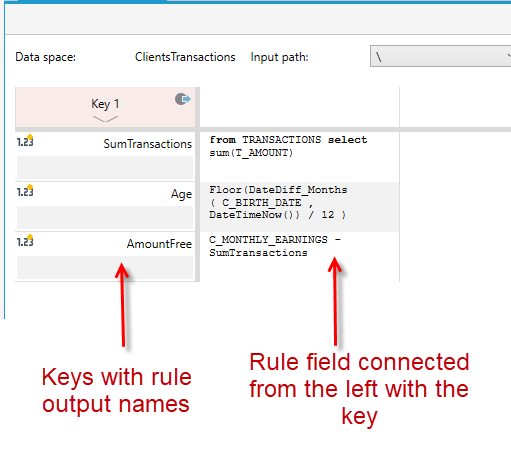
An example of the use of keys as input is periodic aggregates, where months in numeric form can be used as keys, which, when executed, will be used inside the rule for the corresponding calculations.
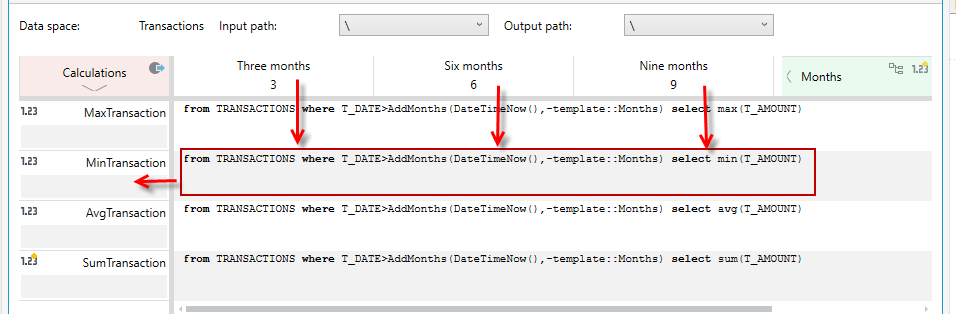
Multidimensional tables are the first choice solution when building calculations in the Decision-Computing Engine. It allows you to create advanced rules in a simple and clear way.
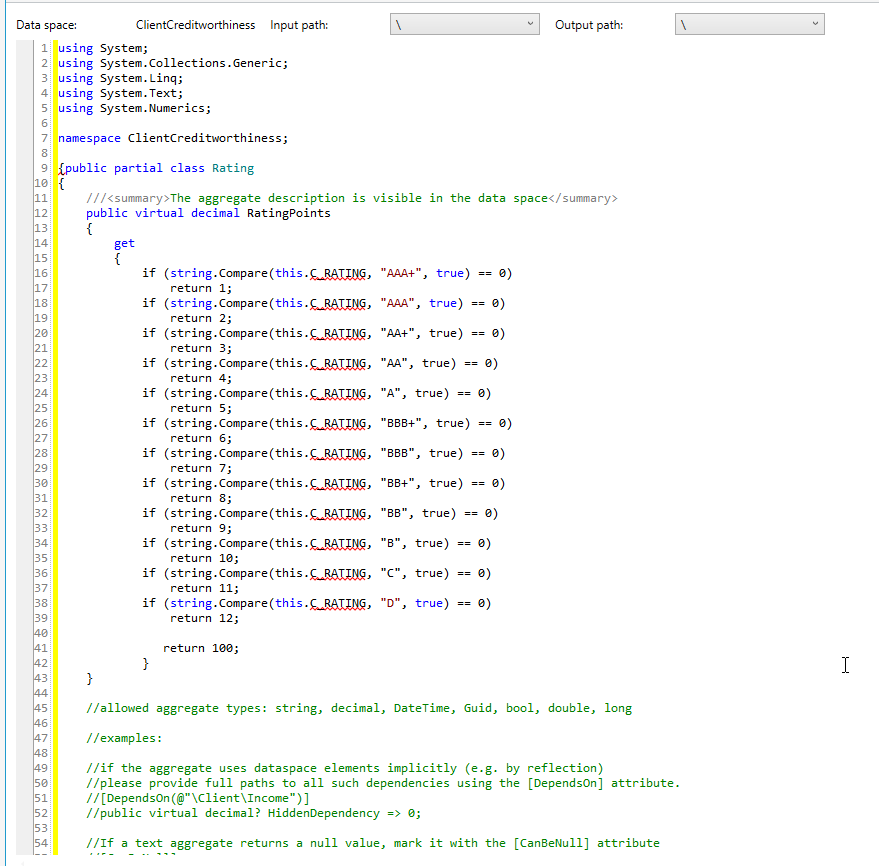
- code in the C# programming language of the .NET platform - If there are specific requirements for the decision and calculation engine, it is possible to program them in C# and use them to perform the transformation. Editing of the aggregate code takes place in the archITekt Studio tool in an ergonomic designer equipped with a syntax prompting mechanism for the C# language and a real-time syntactic analysis of the created code. No external developer tools are required to build and run it. For more see C# Language.
Processing package
The final element is to build a processing package, in which we refer to the built SDO aggregates. For more see Processing package.